
Description
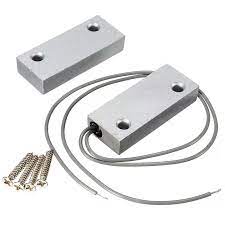
Metallic magnetic contact
Ncomponents
- Reed switch: A glass-encased switch containing two thin, ferrous reeds. It is highly responsive to magnetic fields.
- Magnet: A permanent magnet mounted on the movable part of the door or window.
- Housing: A sturdy metal casing (often steel or aluminum) that protects the reed switch and provides durability and tamper resistance.
- Wiring: Two or more wires connect the contact to the security system. Some contacts may have additional wires for tamper monitoring.
How it works
- Closed state: When the door or window is shut, the magnet is close to the reed switch. In a normally closed (NC) system, the circuit remains complete. In a normally open (NO) system, the circuit remains broken.
- Open state: When the door or window is opened, the magnet moves away from the reed switch. This disrupts the magnetic field. For an C system, the circuit breaks and triggers an alarm. For an O system, the circuit completes and triggers an alarm.
MC Electrical and mechanical specifications
- Rated Voltage: Up to 100VDC100 cap V cap D cap C 100𝑉𝐷𝐶
- Rated Current: Up to 500mA500 m cap A 500𝑚𝐴 or 0.5A0.5 cap A 0.5𝐴
- Power Rating: Up to 10W10 cap W 10𝑊
- Switch Cycle Endurance: Over 100,000100 comma 000 100,000 cycles
- Connection Mode: Normally Closed (NC) or Normally Open (NO)
Performance and design specifications
- Sensing Distance: Typically 50−70mm50 minus 70 mm 50−70𝑚𝑚 or 1.9−2.71.9 minus 2.7 1.9−2.7 inches
- Material: Often zinc alloy or other durable, metallic materials to resist corrosion and for use on metal doors
- Cable/Wire: Often protected by a stainless steel hose or similar durable casing
Applications
- Residential, commercial, and industrial security: Used to monitor the status of doors, windows, and other access points to detect unauthorized entry.
- Tamper resistance: The metallic construction is more robust than plastic versions, making them suitable for environments where a higher level of security is required.
Reviews
There are no reviews yet.